Extension spring vs Belt-drive opener
Extension springs stretch along the tracks; a belt-drive opener pulls the door. Compare how they share load, what fails first, and what each costs.
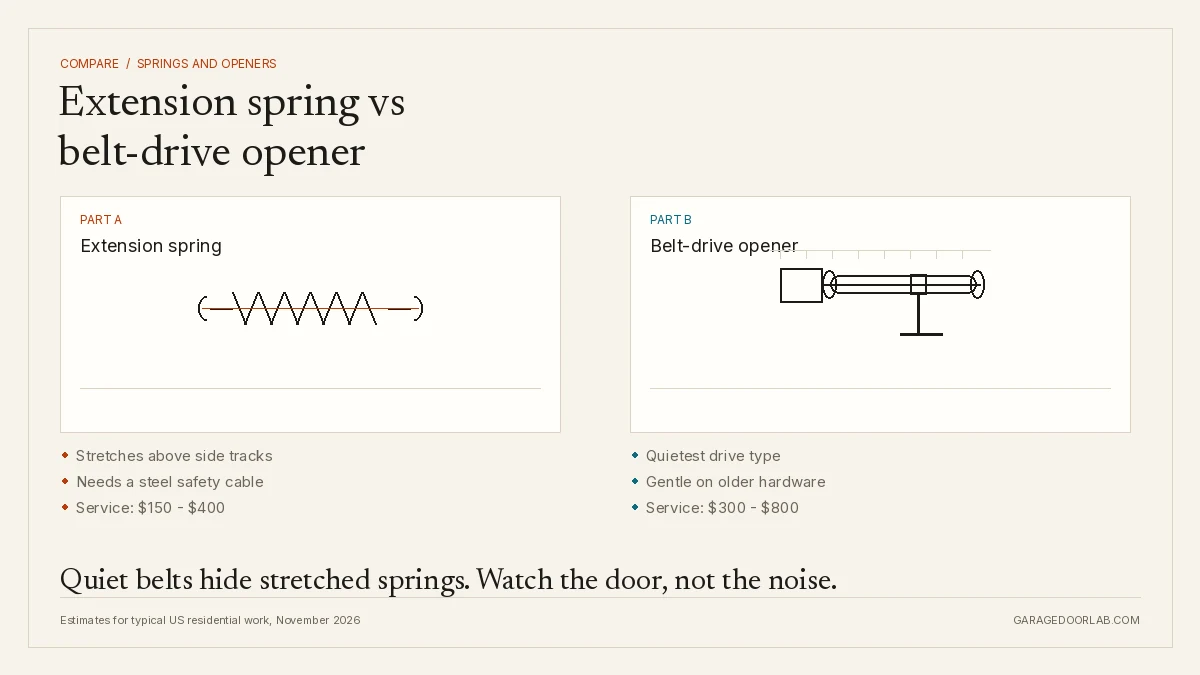
They are two different parts. Extension springs stretch along the side tracks to counterbalance the door; a belt-drive opener pulls it open and closed. Extension springs need safety cables, and a quiet belt drive can hide a spring that has stretched out of spec.
- Extension spring location
- Above the horizontal tracks
- Belt-drive location
- Ceiling or header wall
- Spring replacement
- $150 - $400
- Opener installation
- $300 - $800
- Safety cables
- Required on extension springs
Some links on this page are affiliate links.If you buy through them we may earn a commission at no extra cost to you. We do not accept payment for rankings. Read the full disclosure.
An extension spring and a belt-drive opener are not competing options. The spring is a counterbalance part that stretches along the horizontal track; the opener is the motor and belt that moves the door. The reason homeowners compare them is that both are involved when a door gets heavy, noisy, or slow, and the symptoms overlap enough to confuse which part is at fault.
This guide separates the two, explains why extension springs carry a safety rule that torsion springs do not, and shows what each service costs in 2026.
Two Parts, Two Jobs
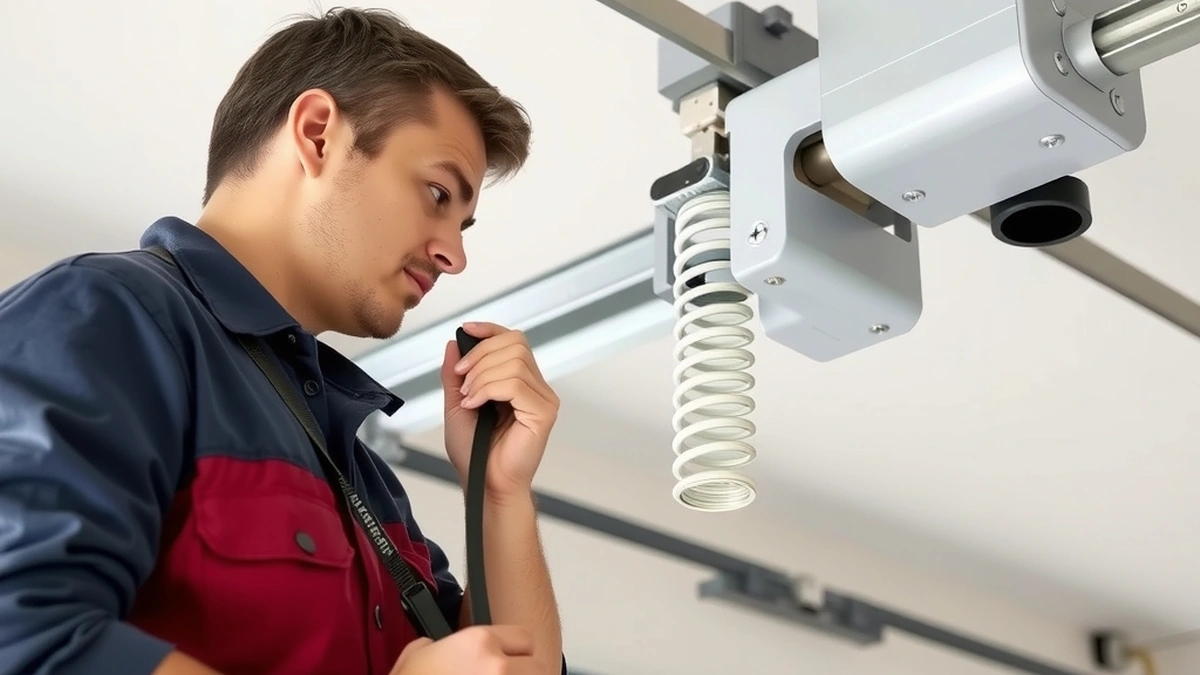
An extension spring is a coil that stretches lengthwise, mounted above the horizontal track on each side of the door. As the door closes, the spring stretches; as it opens, the spring contracts and pulls the door up. Most residential doors with extension springs use one spring per side, and the pair must be matched.
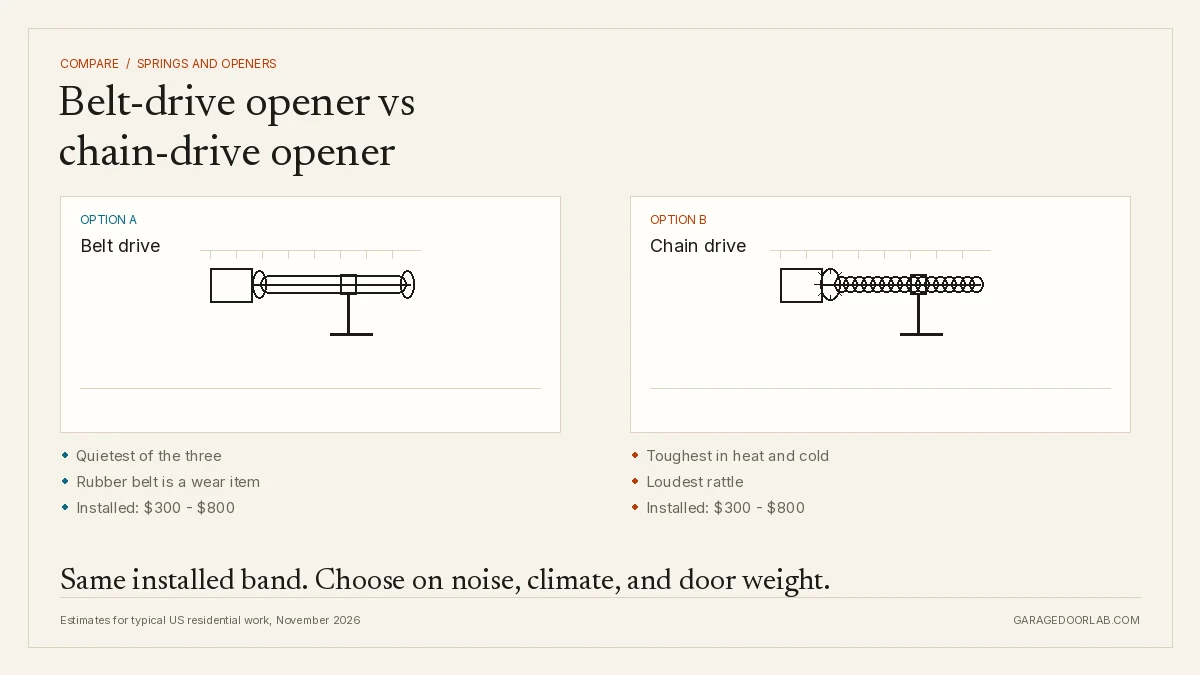
A belt-drive opener is a ceiling-mounted motor that drives a trolley along a rail with a reinforced rubber belt. It pulls the door arm, and the door follows its tracks. The belt is the quietest drive medium, which is why these openers are common in garages beneath living space.
The definition worth remembering: an extension spring stores energy by stretching, and a belt-drive opener converts electricity into a pull. The spring makes the door weigh less; the opener does the pulling.
Why Extension Springs Have an Extra Rule
A torsion spring fails in place, wound around a shaft. An extension spring fails by letting go, and the loose half can travel. That is why every extension spring must have a steel safety cable running through its center, anchored to the bracket at one end and the track or framing at the other.
If the cable is missing, rusted through, or clipped short, the door is unsafe even if the spring looks fine. This is a visual check you can make from the floor: look for a steel wire passing through the middle of each spring and anchored at both ends. If you cannot see one, stop using the door and book service.
Never try to fit a safety cable yourself. The spring must be unloaded first, and that procedure releases stored energy in a controlled way that requires the right clamps and the right sequence.
How a Belt Drive Behaves on an Extension-Spring Door
A belt drive is gentle. It starts and stops smoothly, and it puts less vibration into the door hardware than a chain drive. On an older door with extension springs, that smoothness is an advantage, because vibration is what loosens brackets and works fasteners out of wood framing.
The downside is feedback. A belt drive is so quiet that a spring going out of adjustment is easy to miss. Watch for these signs instead of listening for them:
- The door opens crooked, with one side lagging.
- The door drifts down when stopped halfway.
- One spring hangs visibly looser than its partner.
- The opener strains at the start of travel but runs fine afterwards.
- The door bangs at the top of travel when it fully opens.
Any of these points to balance, not to the motor. A new belt-drive opener will not fix a stretched spring, and it will run hotter trying.
Side-by-Side
| Aspect | Extension spring | Belt-drive opener |
|---|---|---|
| Movement | Stretches along the track | Pulls the door arm |
| Mounting | Above each horizontal track | Ceiling or header |
| Typical cost | $150 - $400 | $300 - $800 |
| Failure mode | Snaps and can travel | Belt fray, motor or gear failure |
| Required safety part | Steel safety cable | Proper rail and trolley |
| Homeowner service | Visual check only | Belt, force, and reverse tests |
| Noise level | Bang when it breaks | Quiet hum in normal use |
What the Numbers Look Like
Prices are estimates for typical US residential work and move with door size and local labor.
- Extension spring replacement: $150 to $400.
- Belt-drive opener installation: $300 to $800.
- Both on the same visit: $150 + $300 = $450 low; $400 + $800 = $1,200 high.
- Spring plus cable repair: $150 + $150 = $300 low; $400 + $350 = $750 high.
- Emergency call-out: add $250 to $500.
A matched pair is usually replaced together, and the $150 to $400 figure covers that for most residential doors. If a technician quotes one spring only, ask why the pair is not being matched. Mismatched springs are the most common reason a door opens crooked after a repair.
For a full breakdown, see our extension spring cost guide and the belt-drive opener installation guide. If the door also needs cable work, the snapped cable repair guide explains the overlap.
When to Replace the Opener Instead
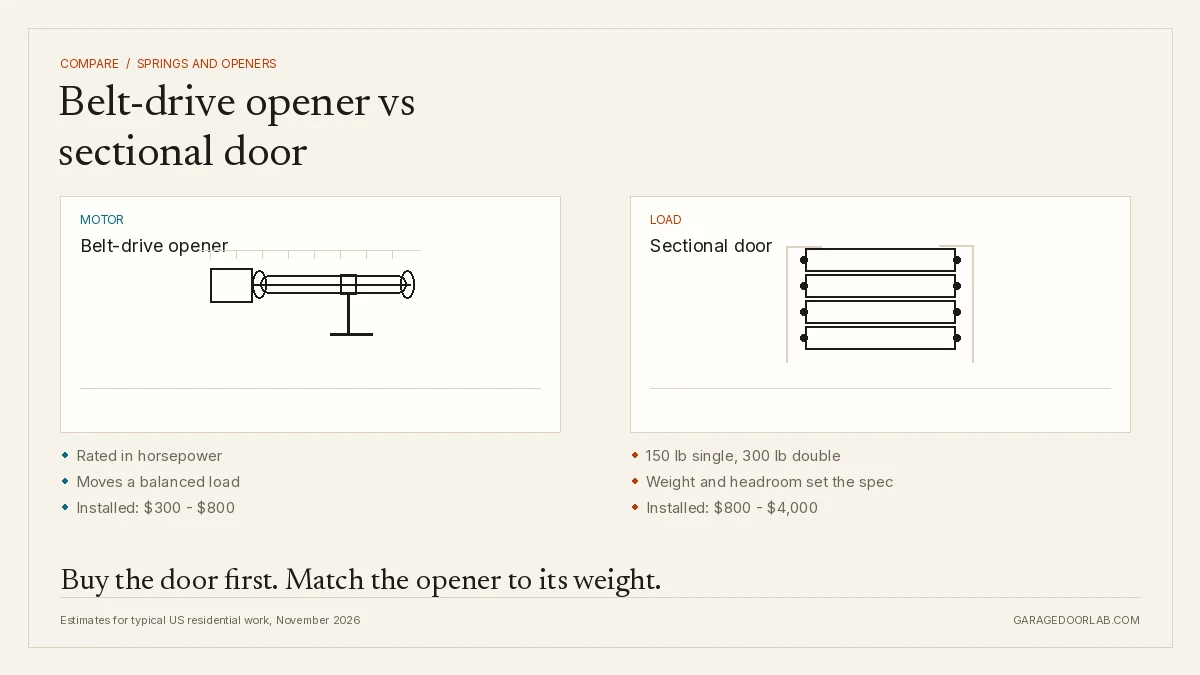
Replace the opener when the motor is failing, the logic board is dead, or the unit is old enough that parts are scarce. Do not replace it because the door is heavy. Heavy is a spring symptom.
A reasonable test order:
- Disengage the opener and lift the door by hand. A balanced door stays where you leave it.
- If it will not stay, the spring is the fault, and the opener is innocent.
- If it stays but the opener still strains, check the belt tension and the force setting.
- If the opener is over 12 years old and the spring is sound, a new unit at $300 to $800 is a fair spend.
What to Do Next
- Look for a safety cable through each extension spring before you run the door again.
- Disengage the opener and test the door balance at the halfway point.
- Photograph both springs, the opener label, and the door’s bottom section.
- Book a technician if a spring is slack, the door is crooked, or a cable is missing.
- Ask for the spring pair, the cables, and the labor to be itemized separately on the quote.
For more on safe homeowner checks, read garage door repair maintenance. Our extension spring problems guide covers the failure patterns in detail.
Bottom Line
The extension spring balances the door and the belt-drive opener pulls it. Spring replacement runs $150 to $400 and opener installation runs $300 to $800, and the spring should always come first. Extension springs need intact safety cables, and neither the cable nor the spring is a homeowner job. If the door is crooked, heavy, or missing a safety cable, stop using it and call a qualified technician.
Frequently asked questions
Do extension springs work with a belt-drive opener?
Yes. Belt-drive openers work with any counterbalance system as long as the door is balanced and the opener is rated for the door's weight.
Why do extension springs need safety cables?
A broken extension spring can whip toward anything in its path; safety cables threaded through the spring contain it.
How much does extension spring replacement cost?
Professional replacement typically costs $150 to $400, similar to torsion spring service, including parts and labor.
Is a belt-drive opener good for an older door with extension springs?
It can be, but the door must first be balanced; a belt drive will not compensate for a stretched or mismatched spring.
What does a stretched extension spring look like?
It hangs looser than its pair, the door opens crooked, and the spring may no longer sit squarely over its track.
Can I replace an extension spring myself?
No. Extension springs store enough energy to cause serious injury, and the job requires controlled unloading and safety cable fitting.
Sources
Some links are affiliate links.If you buy through them we may earn a commission at no extra cost to you. We do not accept payment for rankings. Read the full disclosure.