Belt-drive opener vs Sectional door
A belt-drive opener moves the door; the sectional door is the door it moves. Compare weight ratings, noise, headroom, and repair costs before buying.
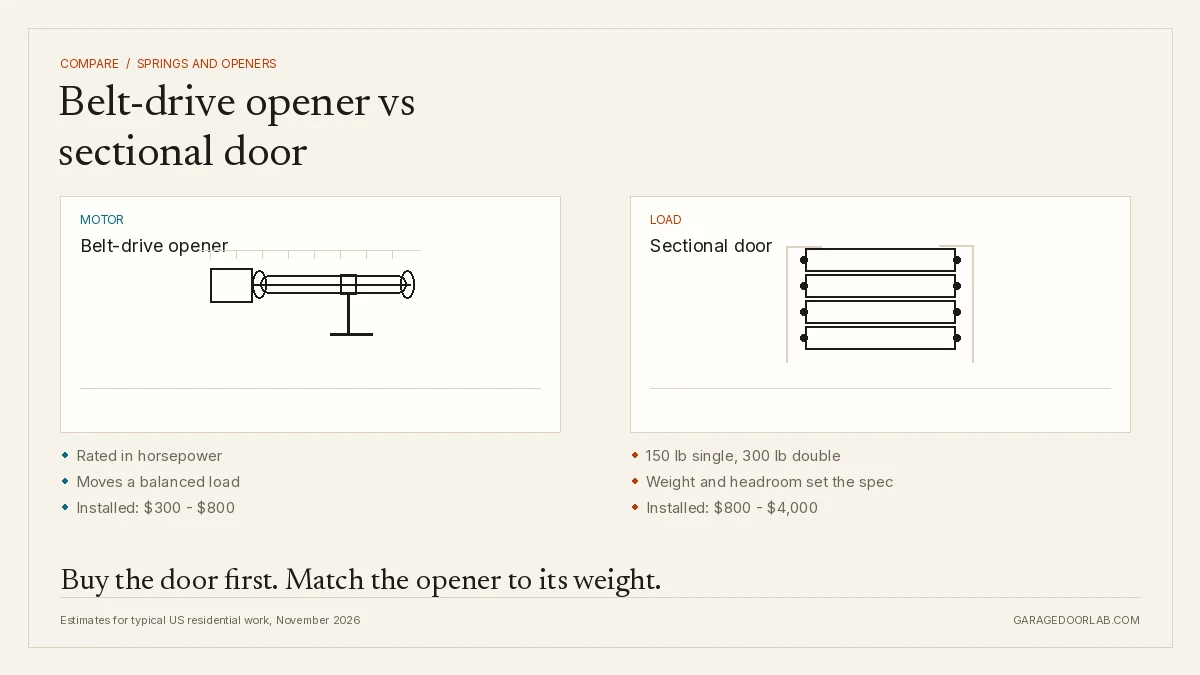
A belt-drive opener is the motor and rail that moves the door; a sectional door is the multi-panel door assembly. They are bought separately, and the opener must be rated for the door's weight, so a heavier insulated door can require a stronger unit.
- Belt-drive job
- Moves the door quietly
- Sectional door
- Hinged panels in tracks
- Opener installation
- $300 - $800
- New door installed
- $800 - $4,000
- Matching rule
- Opener rating must exceed door weight
Some links on this page are affiliate links.If you buy through them we may earn a commission at no extra cost to you. We do not accept payment for rankings. Read the full disclosure.
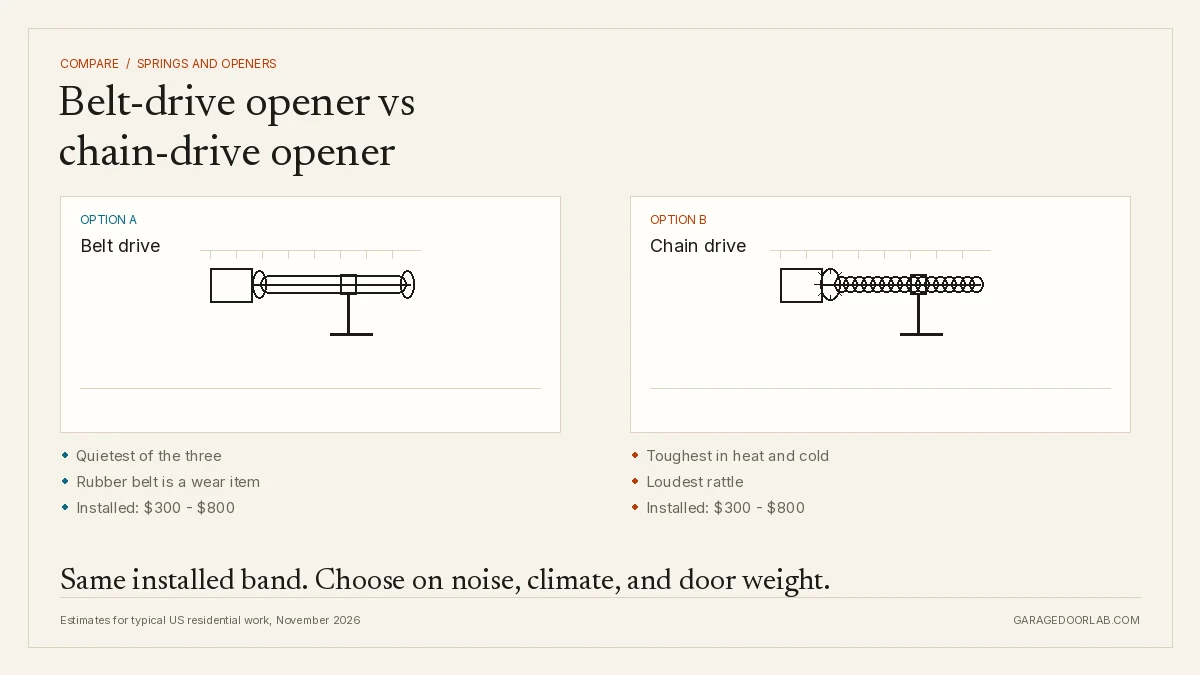
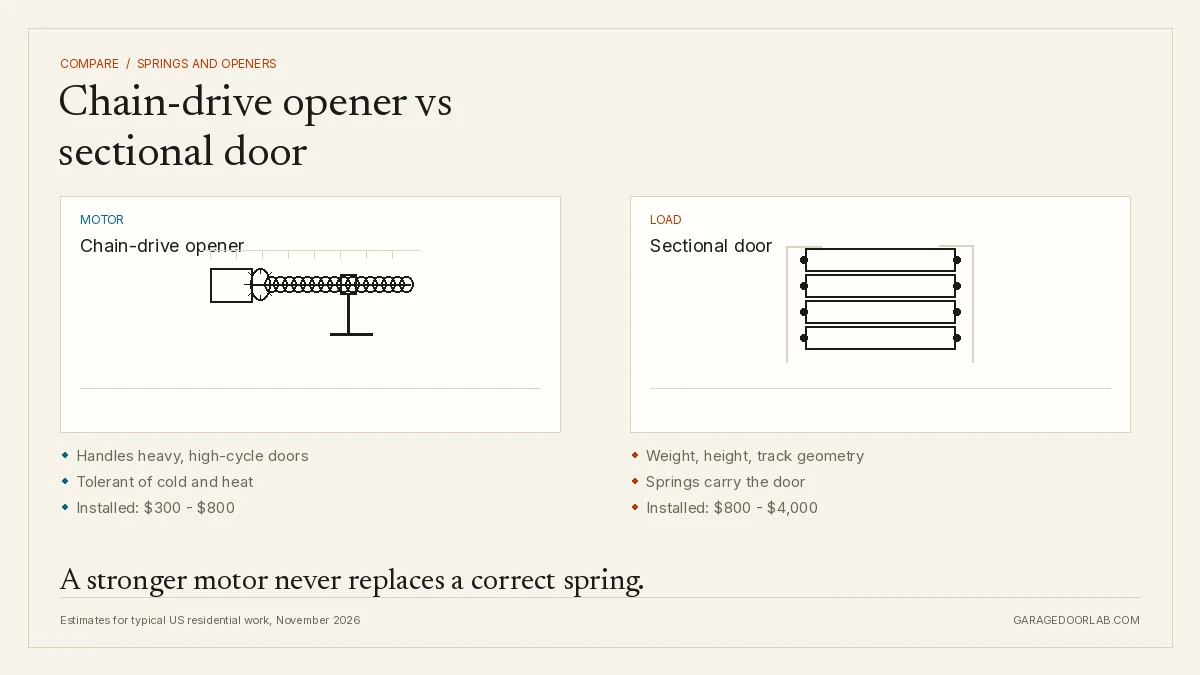
A belt-drive opener and a sectional door are not alternatives, and they are not sold as a pair by default. The sectional door is the assembly of hinged panels that fills the opening. The belt-drive opener is the ceiling-mounted motor and rubber belt that pulls it. You can replace either one without the other, and the only rule that binds them is weight.
That rule is where most buying mistakes happen. A homeowner fits a quiet belt drive to a new insulated door and wonders why it strains. The opener was rated for the old 150-pound door, not the new 300-pound one.
Motor Versus Door
A sectional door consists of four or five horizontal panels, hinges, rollers, vertical and horizontal tracks, a bottom seal, and a counterbalance system. It is the visible product and the part that determines how much weight has to move.
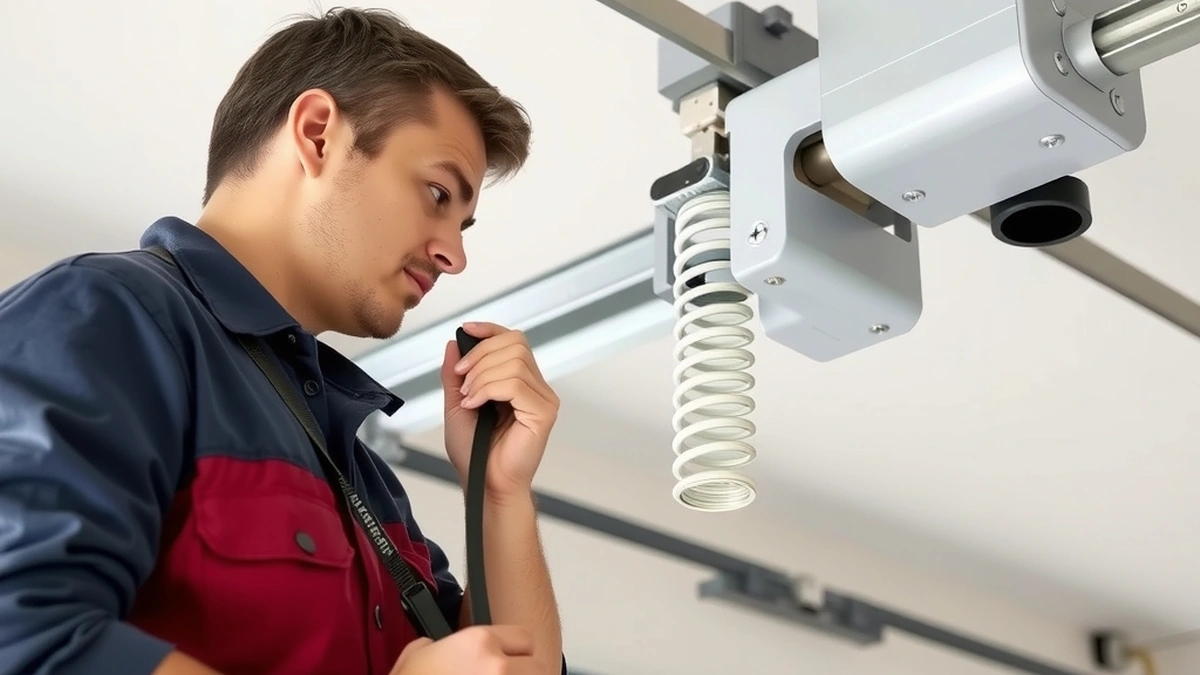
A belt-drive opener is a motor, a rail, a trolley, and a reinforced rubber belt. It mounts to the ceiling or the header and pulls the door arm. Its job is traction, not lift; the door’s springs carry the weight.
The definition: a sectional door is the load, and a belt-drive opener is the mover. Match the mover to the load.
What a Belt Drive Needs From the Door
Three things, in order of importance.
First, a balanced door. The springs must be sized to the door’s actual weight. A belt drive is smooth and quiet, but it is not strong, and it will overheat trying to lift a door whose springs have given up.
Second, correct headroom. A sectional door needs roughly 12 to 15 inches above the opening for the horizontal track and the opener rail. A belt-drive rail is slimmer than a chain rail, which helps in tight ceilings, but the door still needs its track clearance.
Third, a solid mounting point. The header above the door must take the rail bracket, and the ceiling must take the motor’s weight. Older garages with a sagging header need that checked before an installer hangs a new unit.
How Door Weight Changes the Calculation
A basic single steel door might weigh around 150 pounds. An insulated double door with steel skins commonly exceeds 300 pounds. Openers are rated in horsepower and lift capacity, and a standard half-horsepower unit is comfortable on a typical single door but marginal on a heavy double.
The arithmetic is simple. If the door weighs 300 pounds and the springs cancel most of that, the opener sees perhaps 30 to 50 pounds of effective load and runs easily. If the springs are wrong for the new door, the opener sees far more and the motor runs hot. That is why a door swap without a spring check is a false economy: a door costing $800 to $4,000 can take a $300 to $800 opener down with it.
A quiet belt drive is also less forgiving of imbalance than a chain. It has no slack to absorb a surge, so a heavy spot shows up as a slow start and a labored finish.
Side-by-Side
| Aspect | Belt-drive opener | Sectional door |
|---|---|---|
| What it is | Motor, rail, and belt | Panels, tracks, and hardware |
| Role | Moves the door | Is the door |
| Cost | $300 - $800 installed | $800 - $4,000 installed |
| Service life | About 10 to 15 years | 15 to 30 years |
| Partial repair | Belt, gear, or board | Single panel $200 - $600 |
| Key spec | Lift capacity and horsepower | Weight, height, and insulation |
| Homeowner service | Reverse and force tests | Washing, lubrication, seals |
Costs: Opener, Panel, or Door
Prices are estimates for typical US residential work and vary by market and door size.
- Belt-drive opener installed: $300 to $800.
- One replacement panel: $200 to $600.
- Opener plus one panel: $300 + $200 = $500 low; $800 + $600 = $1,400 high.
- New sectional door installed: $800 to $4,000.
- New door plus new opener: $800 + $300 = $1,100 low; $4,000 + $800 = $4,800 high.
- Spring replacement if the new door needs it: add $150 to $400.
That last pairing is the one to plan for. A door and opener bought together at the low end is $1,100; at the high end it is $4,800. Getting the weight rating right the first time is what keeps you at the low end.
Our belt-drive opener cost guide and sectional door cost guide break these out line by line.
Matching a Belt Drive to a Sectional Door
Work in this order and the numbers line up.
- Weigh or look up the door. The manufacturer’s spec sheet lists panel weight per square foot.
- Add hardware: hinges, rollers, struts, and glass or insulation.
- Check the opener’s rated lift capacity against that total.
- Confirm headroom above the opening for the rail and track.
- Confirm the spring system is sized for the same weight, because the opener’s rating assumes a balanced door.
If you are keeping an existing opener and buying a heavier door, ask the installer to confirm the unit’s capacity in writing. A belt drive that was fine on a thin door can be undersized on an insulated one, and the symptom is a slow, labored open that gets worse in cold weather.
What to Do Next
- Note the door’s panel count, height, and whether it is insulated.
- Find the opener’s model plate and its horsepower or lift rating.
- Test the door balance with the opener disengaged.
- Get a written quote that lists the door weight, the opener capacity, and the spring size.
- If either figure is missing, ask before you sign.
For the safety side of the same system, read garage door repair maintenance. If you are still deciding on a drive type, our belt-drive vs chain-drive comparison covers noise and durability.
Bottom Line
The sectional door is the load and the belt-drive opener is the mover. Opener installation runs $300 to $800, a new door runs $800 to $4,000, and a single panel runs $200 to $600. Buy the door first, match the opener to its weight, and confirm the springs are sized for the same figure. A quiet motor on an unbalanced door is not a quiet motor for long.
Frequently asked questions
Does a belt-drive opener work on any sectional door?
It works on any sectional door within its rated lift capacity, but heavier insulated doors may need a higher-horsepower unit.
Do I need a new opener when I buy a new sectional door?
Not always, but the existing opener must be rated for the new door's weight and fitted with the correct arm bracket.
Why is my belt-drive opener straining on a new door?
The new door is likely heavier than the old one, or the springs were sized for the previous door, so the opener is lifting more load.
How much does a sectional door cost installed?
A new sectional door typically costs $800 to $4,000 installed, depending on size, insulation, and material.
Can a belt drive lift an insulated double door?
Many can, but check the unit's rated capacity; a heavy double door may exceed a standard half-horsepower opener.
Which comes first, the door or the opener?
Choose the door first, then match the opener to its weight and headroom; the door determines the load the motor must move.
Sources
Some links are affiliate links.If you buy through them we may earn a commission at no extra cost to you. We do not accept payment for rankings. Read the full disclosure.