Chain-drive opener vs Sectional door
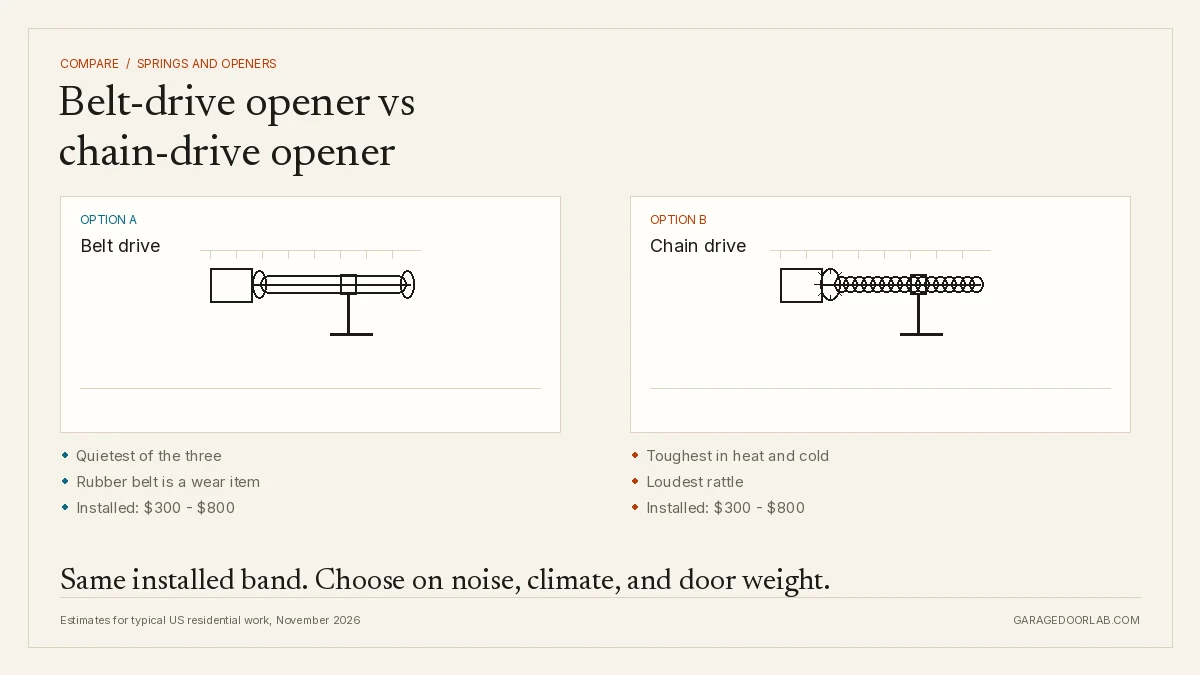
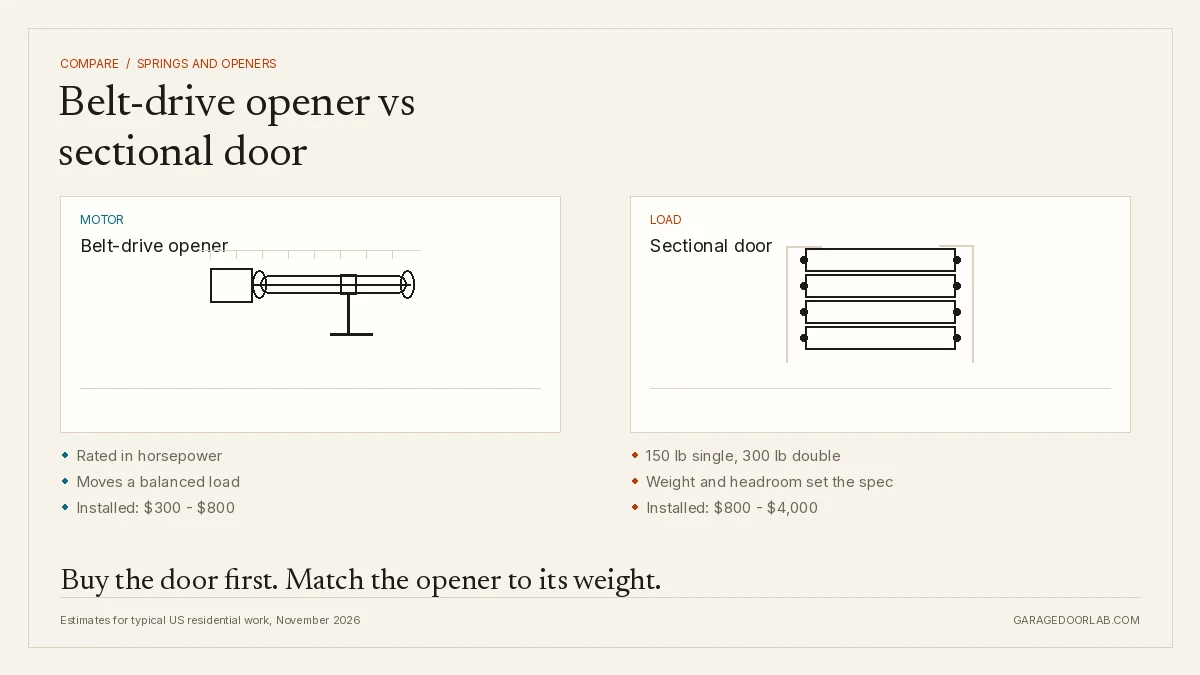
A chain-drive opener is the motor that pulls the door; a sectional door is the load it pulls. Compare duty ratings, heavy doors, noise, and repair costs.
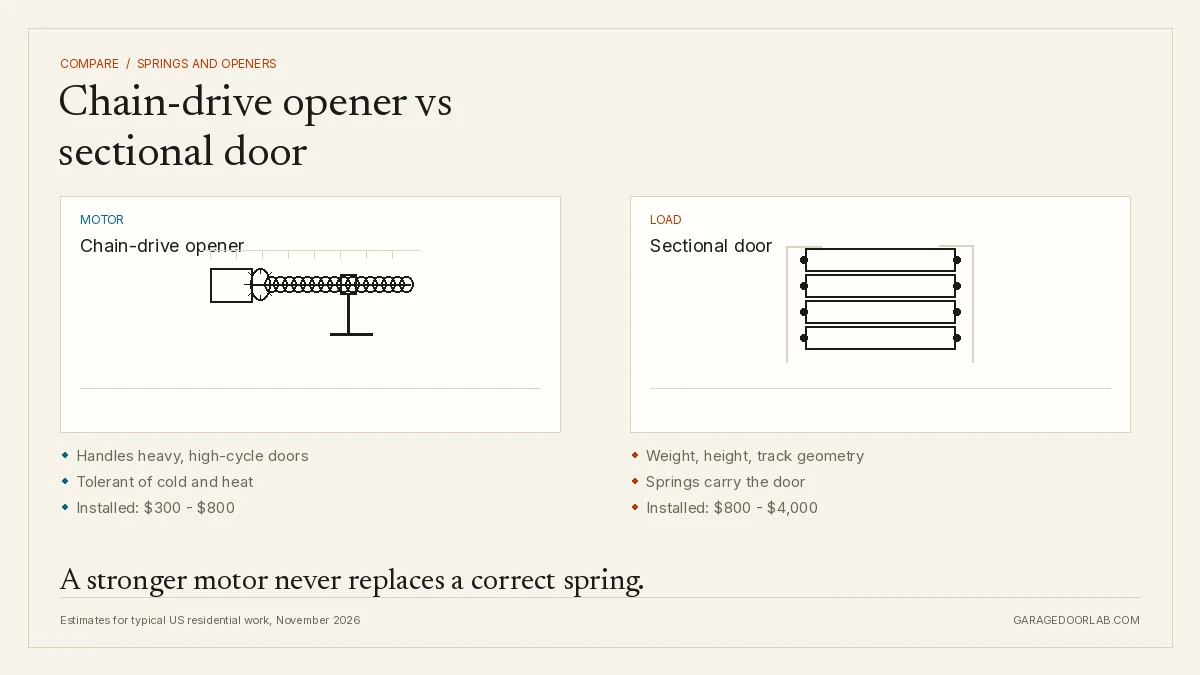
A chain-drive opener is the motor and steel chain that pulls the door; a sectional door is the multi-panel load it moves. Chain drives are the usual pick for heavy or high-cycle sectional doors, but the door's springs still carry the weight.
- Chain-drive role
- Pulls the door along the rail
- Sectional door role
- The load being moved
- Opener installation
- $300 - $800
- New door installed
- $800 - $4,000
- Best fit
- Heavy or high-cycle doors
Some links on this page are affiliate links.If you buy through them we may earn a commission at no extra cost to you. We do not accept payment for rankings. Read the full disclosure.
A chain-drive opener and a sectional door are a motor and its load, not two competing products. The sectional door is the panel assembly that fills the opening, and the chain-drive opener is the ceiling unit that pulls it along the tracks. The comparison matters at specification time, because a chain drive is the usual choice for the heavier end of the sectional market and the wrong rating shows up as a strained motor within a season.
This guide covers why chain drives suit big sectional doors, what the door adds to the calculation, and what each repair costs.
The Motor and the Load
A sectional door is built from four or five hinged panels that fold back along horizontal tracks. It carries its own weight through rollers, hinges, and a counterbalance system. The door is the load, and its weight, height, and track geometry set every other number in the system.
A chain-drive opener is a motor on the ceiling driving a steel chain loop along a rail. The chain moves a trolley, the trolley moves the door arm, and the door travels its tracks. It is the most common residential drive type and the most tolerant of heavy doors and temperature extremes.
The definition: a chain-drive opener supplies pulling force, and a sectional door supplies the mass that force has to move.
Why Chain Drives Suit Bigger Sectional Doors
Three reasons, and none of them is raw power.
The first is heat tolerance. A chain does not care about a 120°F garage or a 10°F morning. A belt can stiffen in cold and dry out in heat, which matters on a large door that takes longer to travel and keeps the motor running.
The second is duty cycle. A heavy door moved several times an hour, as in a workshop or a rental property, puts more cycles on the opener. Chain drives handle that repetition with fewer complaints, and higher-horsepower units with chain drives are readily available.
The third is cost at the top end. When you need a stronger unit, the chain version is usually the cheaper way to get the capacity. A belt drive at the same rating costs more, and the belt becomes another wear item on a door that is already working the motor hard.
What the Door Adds to the Equation
Weight is the obvious factor. A single uninsulated door might weigh 150 pounds; an insulated double door can exceed 300 pounds. The springs carry that weight, and the opener carries the remainder plus friction. If the springs are undersized for the door, the chain drive will drag the load and overheat.
Geometry matters just as much. A standard 7-foot door with a 12-inch radius track is the easy case. A high-lift door, a full-vertical track, or a low-headroom setup changes how the door travels and how much force the opener applies at each point. Those installations need the opener and the springs specified together, not chosen from a shelf.
Age matters too. An older sectional door with worn rollers and dry hinges adds friction that the opener has to overcome. Replacing rollers and lubricating hinges is cheap; replacing a burnt motor is not.
Side-by-Side
| Aspect | Chain-drive opener | Sectional door |
|---|---|---|
| What it is | Motor, rail, and chain | Panels, tracks, and hardware |
| Role | Pulls the door | Is the load |
| Typical cost | $300 - $800 installed | $800 - $4,000 installed |
| Heat and cold | Unaffected | Panels expand and contract |
| Wear items | Chain, sprocket, trolley | Rollers, hinges, springs, seals |
| Partial repair | Sprocket or trolley swap | Single panel $200 - $600 |
| Key spec | Horsepower and duty rating | Weight and track geometry |
Cost Arithmetic
Estimates reflect typical US residential work and vary by region and door size.
- A replacement chain-drive opener, installed: $300 to $800.
- A new sectional door, installed: $800 to $4,000.
- Door and opener together: $800 + $300 = $1,100 low; $4,000 + $800 = $4,800 high.
- Opener plus one panel: $300 + $200 = $500 low; $800 + $600 = $1,400 high.
- Door, opener, and a spring set: $800 + $300 + $150 = $1,250 low; $4,000 + $800 + $400 = $5,200 high.
- Repair one damaged panel instead: $200 to $600.
- Evening or weekend call-out: $250 to $500 extra.
The pattern is the same every time: the opener is the smaller number, so it should be specified last, after the door’s weight and geometry are known. Our chain-drive opener cost guide and the sectional door cost guide show what belongs in each line.
Noise and Vibration on a Large Door
A chain drive on a big sectional door is loud, and the door amplifies it. Large panels act like a drum, and the chain’s rattle travels into the framing. In a detached garage that is tolerable. Under a bedroom it is not.
Vibration also loosens hardware. On a heavy door, the same vibration that makes noise works on the track brackets, the hinge screws, and the spring hardware. An annual check of bolts and rollers is the cheapest maintenance you can do, and it prevents the slow misalignment that ends with a derailed door.
If noise is the main complaint, the fix is usually a belt drive plus door hardware service, not a new door. If the door is heavy and the garage is detached, keep the chain and spend the money on rollers and springs instead.
What to Do Next
- Record the door’s width, height, panel count, and insulation.
- Find the opener’s horsepower and duty rating on the model plate.
- Disengage the opener and check that the door stays put halfway open.
- Ask the installer to confirm the opener rating against the door weight in writing.
- Get a quote that separates opener, springs, rollers, and labor.
For the safety checks that belong to the homeowner, read garage door repair maintenance. If you are choosing between drive types, our belt-drive vs chain-drive comparison covers the trade-offs directly.
Bottom Line
The chain-drive opener pulls and the sectional door is the load. A chain drive is the right pick for heavy, high-cycle, or extreme-climate doors, but it cannot compensate for weak springs or a worn door. Opener installation costs $300 to $800 and a new door costs $800 to $4,000. Specify the door first, size the springs to it, then match the opener, and leave all spring and cable work to a qualified technician.
Frequently asked questions
Is a chain-drive opener better for a heavy sectional door?
It is more tolerant of heavy doors and repeated use than a belt drive, but the door's springs must still be sized correctly.
What is a duty cycle on a garage door opener?
It is the number of open-close cycles an opener can handle per hour without overheating; heavier doors and frequent use need a higher rating.
How much does it cost to install a chain-drive opener?
Professional installation typically costs $300 to $800, similar to a belt drive, depending on the unit and the door.
Why does my chain-drive opener struggle with a new door?
The new sectional door is likely heavier than the old one, so the opener's rating or the spring sizing no longer matches the load.
Do I need a special opener for a high-lift sectional door?
Yes. High-lift and full-vertical tracks change the travel and load, so the opener and springs must be specified for that geometry.
How long does a chain-drive opener last?
Most residential units last 10 to 15 years, with the chain, sprocket, and trolley as the main wear items.
Sources
Some links are affiliate links.If you buy through them we may earn a commission at no extra cost to you. We do not accept payment for rankings. Read the full disclosure.