Belt-drive opener vs Chain-drive opener
Belt drives are quieter, chain drives are tougher and cheaper. Compare noise, cost, door weight limits, maintenance, and which one fits your garage.
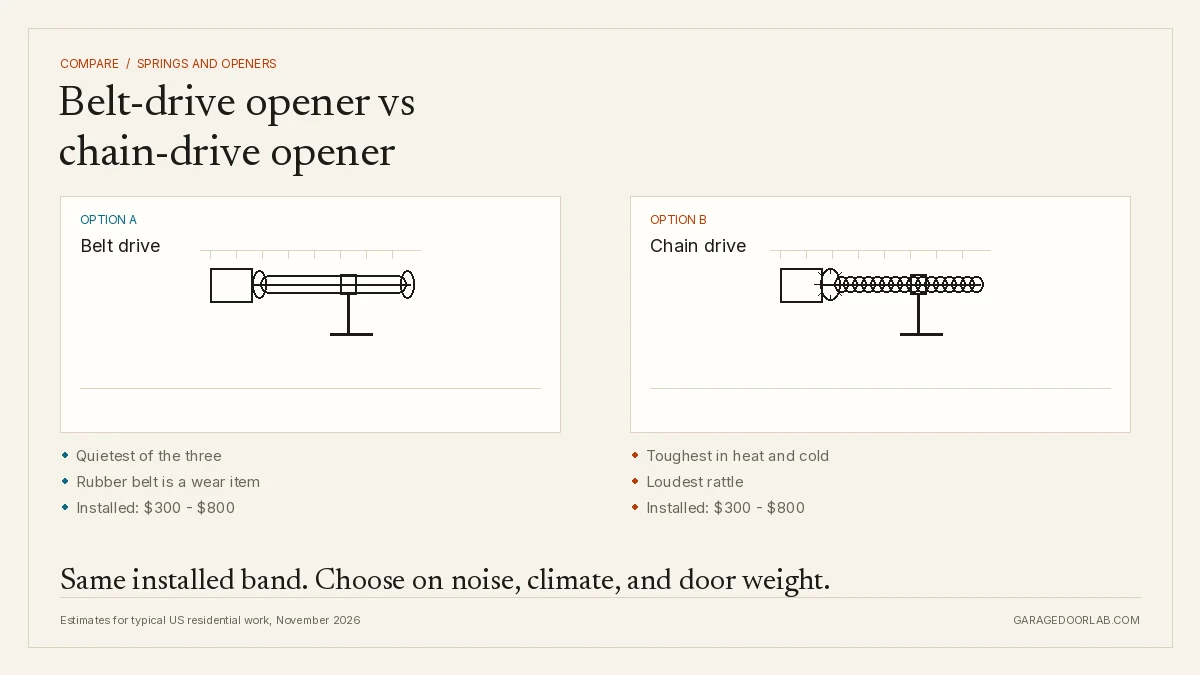
A belt drive runs a rubber belt and is the quietest choice for garages under bedrooms. A chain drive runs a steel chain and is louder but tougher in heat and cold. Both install for $300 to $800, so pick on noise and duty cycle, not price.
- Belt drive noise
- Quietest of the three types
- Chain drive noise
- Loudest, steady rattle
- Installed cost, both
- $300 - $800
- Best for heavy doors
- Chain drive
- Best for attached garages
- Belt drive
Some links on this page are affiliate links.If you buy through them we may earn a commission at no extra cost to you. We do not accept payment for rankings. Read the full disclosure.
This is the rare comparison where both items really are alternatives. A belt-drive opener and a chain-drive opener do the same job in the same place: a ceiling-mounted motor pulls a trolley along a rail to move the door. The difference is the drive medium, and that single choice decides noise, maintenance, and how the unit behaves in a cold garage.
Both install for $300 to $800 in typical US residential work. The decision comes down to where the garage sits, how heavy the door is, and how much noise you can live with.
How Each Drive Works
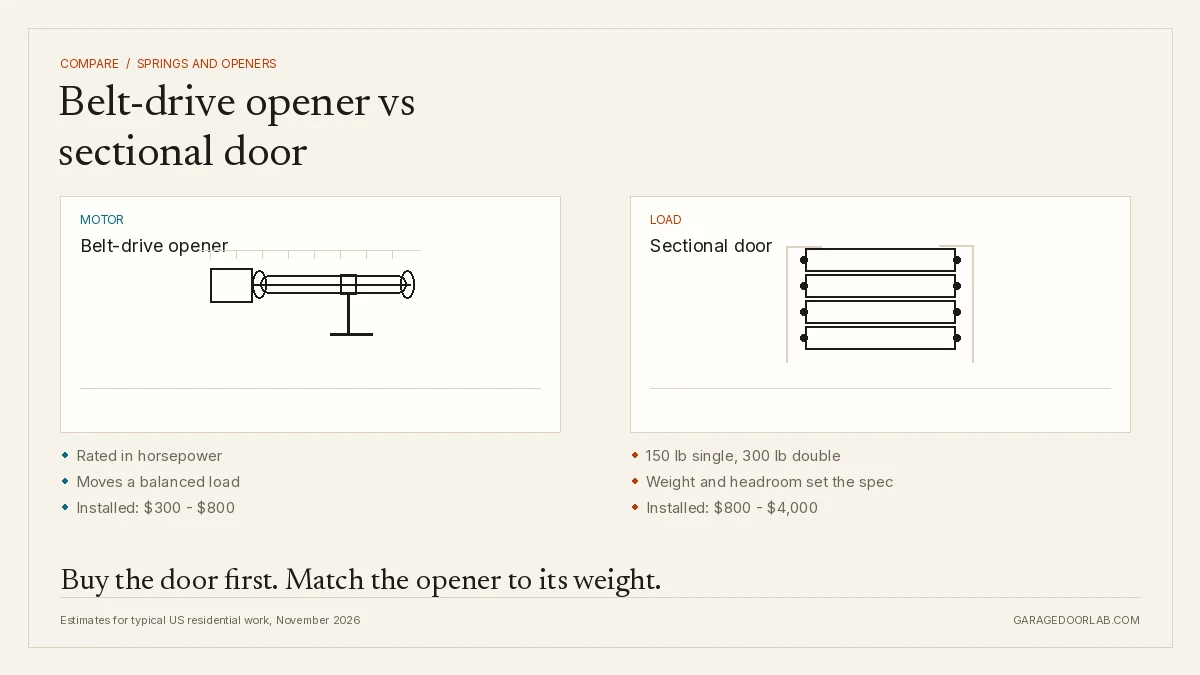
A belt-drive opener uses a reinforced rubber belt, molded with teeth on the inside, running around a pulley at the motor and an idler at the far end of the rail. The belt moves the trolley, and the trolley moves the door arm. The rubber absorbs vibration instead of transmitting it into the ceiling.
A chain-drive opener uses a steel roller chain running over a sprocket. It works the same way mechanically, but metal links against a metal rail produce the rattle that gives chain drives their reputation.
The definition: a belt drive is a rubber-loop traction system, and a chain drive is a steel-loop traction system. Everything else follows from that material difference.
Noise and Where It Matters
A belt drive is the quietest common opener, and the gap is large enough to notice through a floor. If the garage sits under a bedroom, a nursery, or a home office, the belt is the obvious pick. The door itself still makes noise as it rolls and settles, so a belt will not make a door silent, only the motor and rail quieter.
A chain drive is loud. It is not broken, just metallic. The rattle carries through framing, and in a house with a bedroom above the garage it is often the reason people replace a working opener.
There is a second noise source that neither drive fixes: the door. Worn rollers, dry hinges, and a loose track will drown out any drive type. If the goal is quiet, lubricate the door hardware first and then decide whether the opener is the remaining problem.
Cost: Installed, Not Sticker
Both drive types fall inside the same $300 to $800 installed band. Belt units tend to sit toward the upper end because the belt and tensioner cost more than a chain, and chain units sit toward the lower end. The spread is usually tens of dollars in parts, not hundreds.
- Standard replacement, either type: $300 to $800.
- Emergency call-out on top: $250 to $500.
- A door that also needs spring work: add $150 to $400 for the spring.
- Spring plus cable plus opener: $150 + $150 + $300 = $600 low; $400 + $350 + $800 = $1,550 high.
That last figure is the one that catches people. A “dead opener” is sometimes a door with a broken spring dragging the motor down. Check the balance before you buy a new unit. Our how much garage door repair costs guide covers the full pricing picture, and the opener installation guide explains what a proper install includes.
Side-by-Side
| Aspect | Belt drive | Chain drive |
|---|---|---|
| Drive medium | Reinforced rubber belt | Steel roller chain |
| Noise | Quietest | Loudest |
| Installed cost | $300 - $800 | $300 - $800 |
| Cold-weather behaviour | Belt stiffens in extreme cold | Unaffected by cold |
| Heavy doors | Fine up to rated capacity | More tolerant of heavy doors |
| Maintenance | Check belt tension and wear | Lubricate and tension the chain |
| Typical failure | Frayed or stretched belt | Stretched chain, worn sprocket |
| Best location | Under living space | Detached or utility garage |
Durability and Maintenance
A chain drive is the more forgiving of the two. Steel does not care about temperature swings, and a chain that is kept lightly lubricated and correctly tensioned can run for a decade. The wear items are the chain, the sprocket, and the trolley.
A belt drive is smoother but has a consumable belt. In hot climates the rubber can dry and crack; in extreme cold it stiffens until the motor warms it. Belts usually last several years, and replacing one is a normal service item rather than a sign of a bad opener.
Maintenance for either type is simple and safe:
- Test the safety reverse monthly with a 2x4 on the floor.
- Lubricate the chain lightly once or twice a year, or check the belt for fraying.
- Clear debris from the rail and check that the trolley moves freely.
- Listen for a change in sound; new noise means new wear.
- Do not lubricate the belt itself.
Which One Fits Your Door
Choose a belt drive when the garage is attached, the door is a standard residential size, and quiet matters. Choose a chain drive when the garage is detached, the door is heavy or oversized, the climate is extreme, or the budget is tight and the noise does not reach a bedroom.
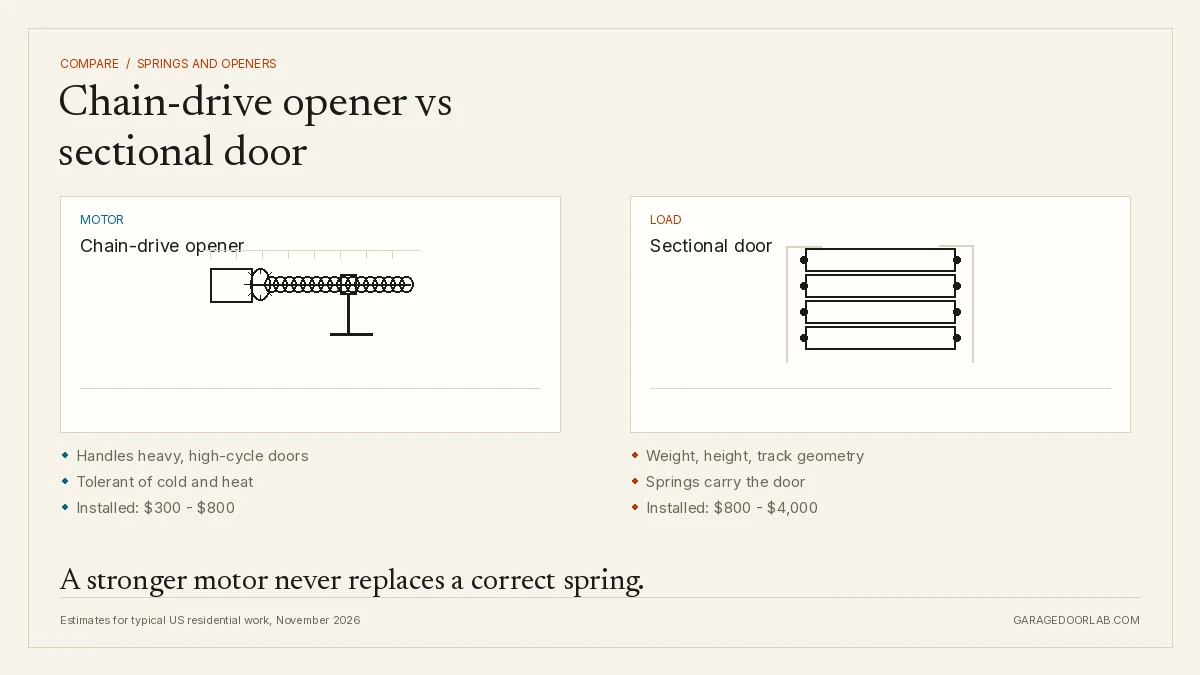
One caveat on heavy doors: no opener should lift a door that the springs are not balancing. A chain drive will drag a heavy door longer before it fails, but it still fails. If the door weighs 300 pounds and the springs are dead, the right fix is a $150 to $400 spring job, not a stronger motor.
If you are also weighing a new door, the sectional door cost guide shows how door weight and insulation affect what the opener has to move.
What to Do Next
- Disengage the opener and lift the door by hand; a balanced door stays halfway.
- Note where the garage sits relative to bedrooms before choosing a drive type.
- Measure the door’s width, height, and weight, and check the opener’s rated capacity.
- Get two quotes in the $300 to $800 band and compare what each includes: rail, remotes, keypad, and disposal of the old unit.
- If the door is noisy too, budget for door hardware service before blaming the opener.
For the spring side of the same decision, our torsion spring vs belt-drive opener and torsion spring vs chain-drive opener comparisons explain how the counterbalance and the drive interact.
Bottom Line
A belt drive is quieter and a chain drive is tougher. Both install for $300 to $800, both need the door to be balanced, and both last around a decade with basic care. Pick the belt for an attached garage under living space, pick the chain for a detached garage or a heavy door, and fix the springs before you spend anything on the motor.
Frequently asked questions
Is a belt-drive opener worth the extra cost?
If the garage sits under a bedroom or living space, yes; the noise reduction is the main benefit and both types install for $300 to $800.
How long does a belt-drive opener last?
Most residential openers last 10 to 15 years, and a belt typically needs replacement before the motor does.
Do chain drives handle heavy doors better?
They tolerate heavier doors, heat, and cold better than belts, which makes them common on larger double doors.
How often should I lubricate a chain?
Once or twice a year with a manufacturer-approved lubricant; over-oiling attracts grit and accelerates wear.
Can I replace a chain with a belt on the same opener?
No. The rail, trolley, and drive sprocket differ, so a drive change means a new opener.
Which opener is quieter, belt or screw drive?
A belt drive is generally the quietest, with screw drive close behind and chain drive the loudest.
Sources
Some links are affiliate links.If you buy through them we may earn a commission at no extra cost to you. We do not accept payment for rankings. Read the full disclosure.